
The pharmaceutical landscape is currently experiencing a massive paradigm shift. Over the last three years, Glucagon-Like Peptide-1 (GLP-1) and Glucose-Dependent Insulinotropic Polypeptide (GIP) receptor agonists have completely redefined the treatment of obesity and metabolic syndrome. However, as the initial hype settles, the scientific community is confronting a major hurdle: weight-loss maintenance.
Current first-generation peptide therapies require daily or weekly injections. For many patients, this frequent dosing schedule leads to high dropout rates, commonly referred to as "peptide fatigue." When patients stop their weekly injections, the rebound weight gain is often rapid and severe.
This month, Viking Therapeutics has made headlines by directly addressing this clinical bottleneck. Their latest Phase 2 clinical data regarding the dual agonist VK2735 suggests we are entering a new era of peptide therapy—one focused on long-term, low-frequency maintenance.
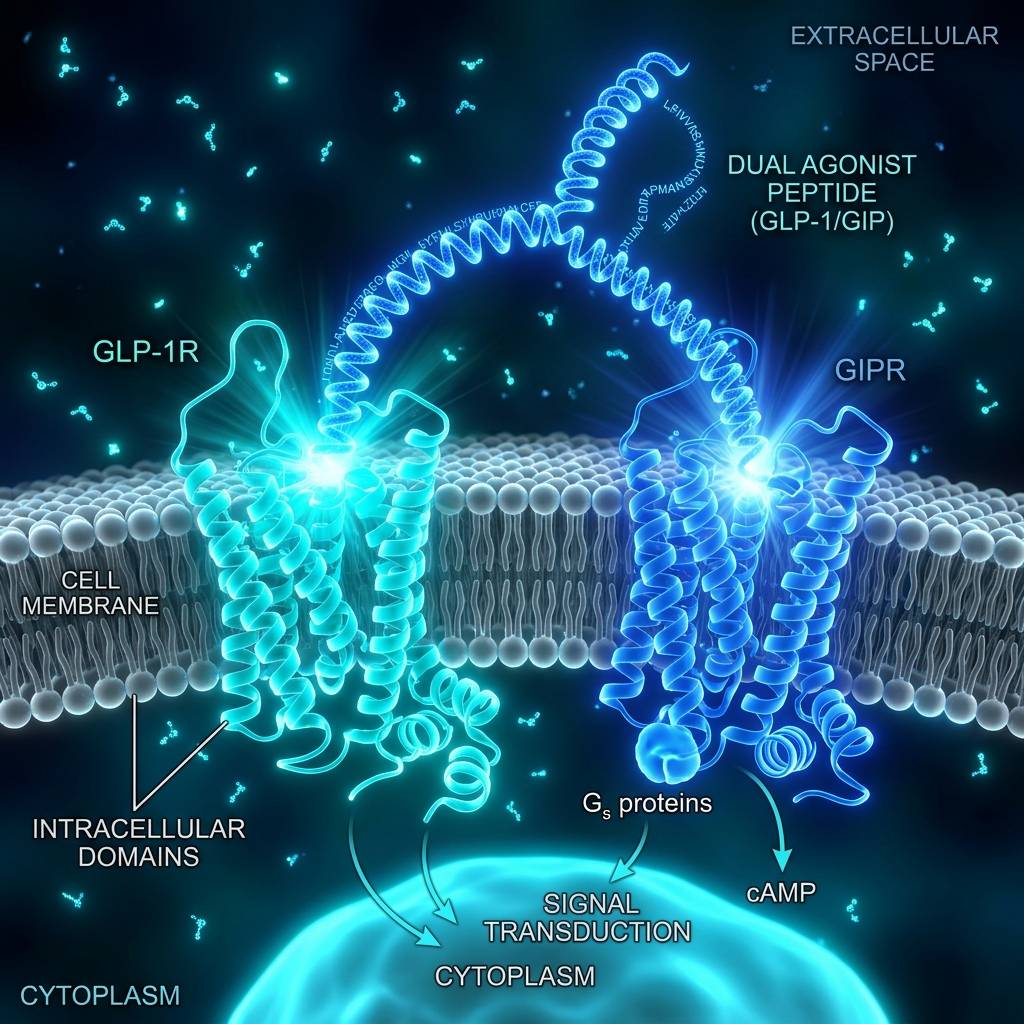
GLP-1 and GIP dual agonist receptor interaction at the cellular level
What is VK2735?
VK2735 is an investigational, dual GLP-1 and GIP receptor agonist developed by Viking Therapeutics. Like the highly successful tirzepatide, it leverages the synergistic effects of targeting both incretin receptors simultaneously.
By agonizing the GLP-1 receptor, the peptide significantly delays gastric emptying, enhances glucose-dependent insulin secretion, and signals satiety to the brain. By agonizing the GIP receptor, it further amplifies these metabolic effects while drastically reducing the gastrointestinal side effects (such as nausea and vomiting) typically associated with pure GLP-1 agonists.
While the exact molecular structure of VK2735 is proprietary, its half-life and pharmacokinetic profile are what truly set it apart in the rapidly crowding metabolic pipeline.
The Phase 2 Maintenance Breakthrough
In September 2026, Viking Therapeutics released highly anticipated data from their Phase 2 maintenance study. The clinical trial (documented on ClinicalTrials.gov) was designed to answer one critical question: Once a patient has achieved their target weight loss using a weekly dosing protocol, can that weight loss be sustained with significantly less frequent dosing?
The data returned an overwhelming "yes."
The study evaluated patients transitioning from a standard weekly injection of VK2735 to a drastically reduced maintenance schedule. The cohorts were divided into patients receiving the peptide on an every-other-week (bi-weekly) schedule and a once-monthly schedule.
The results demonstrated that patients on both the bi-weekly and the monthly maintenance protocols successfully sustained their initial weight loss. Even more remarkably, a statistically significant portion of the cohort actually continued to lose weight while only receiving one injection every 28 days.

Clinical concept illustrating a monthly peptide dosing schedule
Solving the "Peptide Fatigue" Problem
To understand why this is a massive leap forward for endocrinology and metabolic research, we have to look at patient compliance data.
The current standard of care for obesity management involves weekly subcutaneous injections of semaglutide or tirzepatide. While highly effective, researchers are finding that long-term adherence drops significantly after the 12-to-18-month mark. Patients grow weary of managing weekly injections, dealing with the micro-fluctuations in appetite suppression, and managing the associated injection-site reactions.
When patients discontinue weekly therapy, clinical data shows that they often regain up to two-thirds of their lost weight within the first year.
VK2735’s monthly maintenance protocol offers a highly realistic, sustainable path forward. By extending the half-life of the active compound and stabilizing serum concentrations over a 28-day period, Viking Therapeutics is moving peptide therapy away from acute intervention and toward manageable, lifelong chronic care.
The Broader Impact on the Peptide Landscape
Viking Therapeutics’ success with VK2735 is triggering a massive ripple effect across the biomedical landscape.
First, it is forcing major pharmaceutical players like Novo Nordisk and Eli Lilly to accelerate their own extended-release and ultra-long-acting incretin programs. The market expectation has permanently shifted; weekly injections will soon be viewed as an outdated, first-generation modality.
Second, this breakthrough is drastically altering how researchers approach peptide synthesis. To achieve a 28-day active profile, biochemists are exploring advanced peptide engineering techniques, including novel lipid conjugations, PEGylation strategies, and highly specialized amino acid substitutions designed to resist enzymatic degradation by DPP-4.

High-tech biomedical research laboratory focusing on advanced peptide solutions
What This Means for Independent Researchers
For independent researchers and laboratories operating in the peptide space, the VK2735 data reinforces the massive potential of dual-agonist compounds. The synergistic effects of GLP-1 and GIP continue to prove superior to mono-agonists, not only in terms of total fat mass reduction but also in long-term tolerability.
As the industry pivots toward longer-acting compounds, research focuses will naturally transition toward understanding the extended pharmacokinetic profiles, receptor downregulation over 30-day periods, and the long-term metabolic adaptations to sustained incretin signaling.
Note: VK2735 is currently an investigational drug and has not yet received FDA approval for public consumption. All information provided is for educational and research purposes only.
Are you conducting independent peptide research? Ensure your laboratory is stocked with the highest quality, third-party tested compounds.
Click here to view our complete catalog of ISO-9001 certified research peptides.
